Kiran On…. views and insights from the VC frontline
Kiran on…
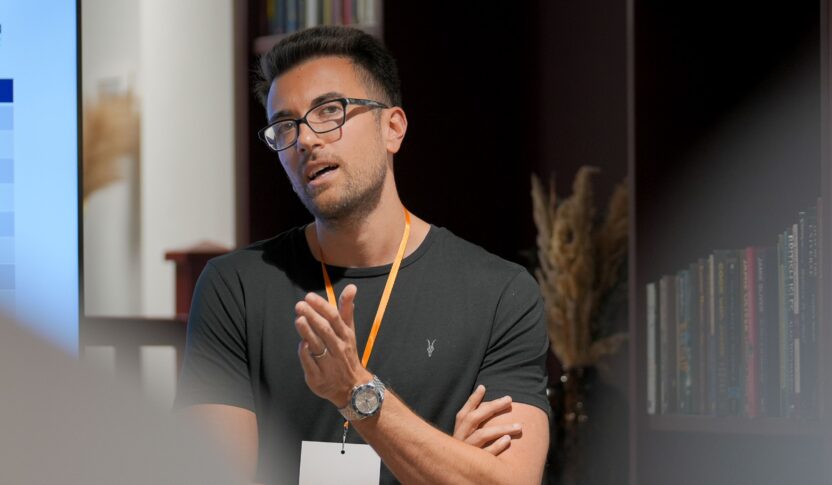
Former tech VC investment manager Kiran Mehta works with the Fhunded team to help identify and support Lancashire startups seeking equity funding. With over 28,000 followers, he is one of LinkedIn’s official top industry voices, and regularly posts candid observations linked to all aspects of early-stage investment.
Below is a summary of some Kiran’s recent insights based on his experience of working with founders. For more, you can follow him on LinkedIn here.
Kiran on… keeping your investors updated
In terms of generic investor updates, there’s no ‘one size fits all’ approach. However, for businesses that are early stage, I would say every six months (or potentially just once a year) is reasonable.
And while some investors may push for more regular updates, in my experience most pre-scale businesses simply don’t generate enough meaningful information to justify quarterly updates. Instead, you’ll find yourself talking about the same thing quarter in quarter out, which doesn’t really help anyone.
Of course, if you’ve already committed to doing quarterly updates with your investors, then I’m not advocating you renege on that agreement.
Also note that if you have any lead investors who are also your board, they’ll require more regular – and more forensic – reporting.
But if nothing’s set in stone, I would recommend you propose updates once or twice a year, maybe with a proviso that you will also inform them if/when something significant happens to the business.
Kiran on… how not all VCs think the same
One of the main reasons raising venture capture can be so challenging is because nearly every VC you encounter will think differently about your proposition.
It’s not like banking or property investment, where analysts usually follow prescriptive process, and ‘tried and tested’ ROI formulas.
Instead, VC decisions tend to be shaped by personal experience, and as a result their attitude to investment opportunities tend to be more nuanced.
In my opinion, this makes a lot of the ‘founder’s golden rules’, and ‘five key things you must have in your pitch deck’, type advice pieces potentially unhelpful.
Or to put it another way, for every VC that wants a detailed long-term growth forecast and exit strategy, others will laugh you out the room if you present anything more than the next 12-18 months. Similarly, some investors think you doing a TAM (Total Addressable Market) analysis is a pointless exercise, while others tell me it’s the first thing they turn to in the deck.
However, once you accept that every investor will view your business differently, it flips how you approach your fundraising strategy and pitch narrative. After all, you can’t control what each investor wants – but you can be clear what you want, how you want to showcase your business, and where you see the business going.
And never forget, you don’t need a yes from everyone, you only need a yes from a handful of the people who get you, and they tend to be the people you’ll want to work with anyway.
Kiran on… over-inflated early-stage job titles
CFO, CTO, CRO, CMO, CSO, CCO, COO, CXO…the ‘roll call’ of over-inflated executive titles which populate so many early-stage pitches can at times seem endless.
And while having a list of such heavyweight job titles may seem relatively harmless at the outset, they can actually come back and bite early-stage founders quite hard over time.
How?
Well, for pre-Series A companies, C-suite roles are often not needed.
In my experience, it is very unlikely you will be able to afford a plethora of such senior heads that are strategically focussed (which is by definition, a C-suite role), but many early-stage companies still allocate them.
However, the issue can that cause a massive headache when that £60k Chief Revenue Officer you appointed in the early days turns out not to be the individual you need to generate the £10m ARR you now need to hit your anticipated revenue targets.
You then have the emotionally-charged challenge of trying to reshuffle your existing team, and/or make a new hire. This in turn can leave people feeling they’re being ‘demoted’, when the fact is they really just had the wrong job title to begin with.
One way to mitigate this is to retain some headroom in your staff hierarchy, recruiting at a level which leaves you some flexibility in the future.
For example, if your newly appointed Marketing Manager demonstrates over their first 12 months or so they have the potential be your CMO, you can promote them with a degree of confidence.
But even when taking a more restrained approach to staffing up, you still need to guard against ‘selling’ prestigious sounding job titles just to try and attract talent.
It may help to fill a gap on your org chart now, but it could you cost further down the road when you seriously start to scale.
Kiran on… the benefits of flying solo
Solo founders are in my view massively underrated.
I always thought the same, even back when I was a VC. That’s why I don’t understand investment funds which have a negative view – and sometimes an actual policy – about never backing solo founders.
Solo founders aren’t necessarily good or bad; they’re just a different proposition.
It can of course be argued that with less bodies in the room, idea generation can be harder, and critical evaluation trickier, especially in the early days.
However, on the upside, a solo founder can make much faster decisions.
They can be more generous with option grants to key employees (potentially making hiring much easier), and bring an agility and responsiveness to the table which a team approach will always struggle to achieve.
They’re also not going to have a co-founder fallout, something which can really derail the growth trajectory of a business (and therefore impact massively on an investor’s ROI).
In my view, it’s not about choosing one or the other as an optimal route, but it is about recognising the pros and cons of going solo.
And if you’re already out there as a sole founder, and feeling a lack of co-founders is making it harder for you to raise, I’d say don’t give up.
History has shown there’s plenty of investors prepared back individual entrepreneurs, and there’s a plethora of hugely successful founders in the world who themselves chose to fly solo.
Kiran on… being prepared
I was recently at a demo day where the tech failed. The 100+ inch projector screen was showing nothing but a circling dot to room full of 400 people. Without missing a stride, the founder pushed on without the slides, and proceeded to nail every second of the sub-three minutes pitch that followed.
Whether or not the projector failed, the lesson is the same; you don’t know what’s going to happen before, during or after your pitch. You can also never anticipate what questions you might be asked, or what the reaction will be once you’ve answered them.
With so many variables, you therefore must be prepared for absolutely anything. Not only that, you must also ensure you know your business, your sector, and your target market, inside and out.
That is the minimum benchmark if you are raising in the current climate.
Anything less could see even the most rock-solid opportunity unravel in seconds (even if the AV is working as it should).
Please note, any views or comments expressed by Kiran are his personal opinions, and are not necessarily shared or endorsed by Lancashire County Council. They should also not be considered as formal financial advice, and should not be used for the basis for making any commercial decisions, including any investments.


