Kiran On…. views and insights from the VC frontline
Kiran on…
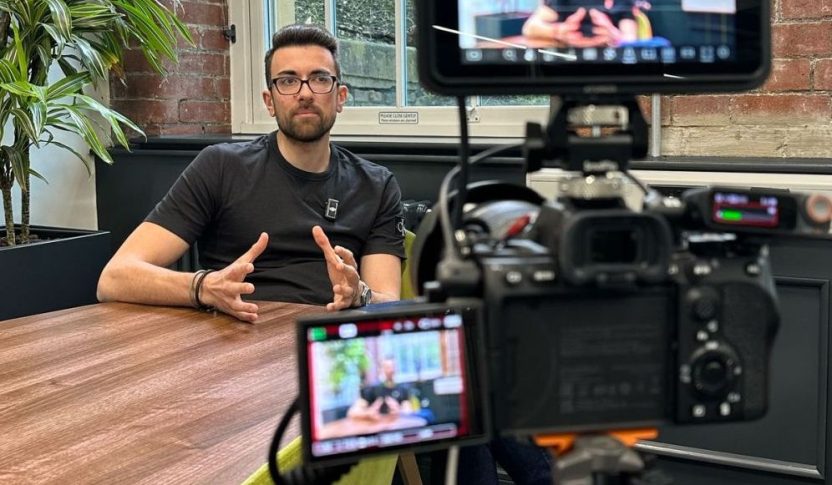
Former tech VC investment manager Kiran Mehta works with the Fhunded team to help identify and support Lancashire startups seeking equity funding. With over 32,000 followers, he is one of LinkedIn’s official top industry voices, and regularly posts candid observations linked to all aspects of early-stage investment.
Below is a summary of some Kiran’s recent insights based on his experience of working with founders. For more, you can follow him on LinkedIn here.
Kiran on… looking beyond revenue
Revenue is one of the most important things in any business. Tech businesses are often valued based on, ARR so it’s clearly one of most important KPIs to look at.
However, focusing solely on revenue alone has caused some of the biggest problems I’ve seen in tech businesses.
Pre-scale, you need to be building a platform that solves one problem for all your customers, not all the problems for one of your customers. However, I’ve often seen businesses veer completely off track from what their broader client base wants in the pursuit of short-term revenue which comes from a niche slice of the market.
I’ve also seen businesses overheat their operational and support teams by signing clients which are clearly a poor fit, only for them to subsequently sap masses of time before (inevitably) churning anyway.
In my experience, this is often an investor led problem, especially in the UK where most only understand outputs and not inputs.
But as a founder, you have to ensure you are the person holding the business accountable for what’s going on underneath the headline numbers.
No amount of revenue is going to help recover from a scattered use case, or perusing a product roadmap which isn’t right for your wider customer-base.
Kiran on… setting the right kind of business goals
If you set yourself or your team the wrong types of goals in your business, the whole venture is potentially going to burn out quickly.
I don’t mean going after the wrong goals, I mean obsessing over uncontrollable metrics, and pressuring your team to meet too many short-term objectives.
For example, if you whip your sales team to hit this month’s revenue target when the business simply isn’t there, don’t be surprised when they miss the next two.
That’s because of focusing on immediate closing – and not on pipeline build – is often not sustainable.
Similarly, if you set your development team tight and unrealistic deadlines for product launches, don’t complain when you get poor customer feedback, along with a buggy product.
And while quick cost-savings like slashing the marketing budget might suddenly make your finances look better on paper, in six months you could be wondering why sales are slowing.
I’m not saying people shouldn’t be held accountable, and that everything should be ‘jam tomorrow’, but in my experience many scaleups end up struggling over the long term by obsessing too much over the short term.
Kiran on… doing less (when things get tough)
One of the most common pieces of advice I give to businesses is to “do less”, especially when things aren’t working as well as they might like them to. However, most people find the proposition quite scary, and it can be met with a lot of resistance.
I get it.
There’s a natural tendency that when things appear not to be working in a business, you feel the need to do something to shake things up.
Developing a new sales strategy, rolling out a different marketing campaign, introducing additional product features, or launching new services altogether, are just some of the ‘quick fixes’ founders deploy in response to a downturn.
However, in my experience, quite often the answer is to do fewer things, but do those fewer things ruthlessly well.
After all, most businesses have a finite amount of resource.
So, if things aren’t quite going to plan, targeting each and every bit of resource you do have into the specific areas of the business which you know actually move the dial can be the key to turning things around.
For example, I’ve seen firms in similar predicaments work out what’s sold in the past, work out their top two sales messages, work out their standout hero features, and simply go all in on those.
It’s a counterintuitive play, but one that might get you through and sustain you until things pick up again.
Kiran on… confusing customer success with customer support
I often find that many growing companies confuse customer support with customer success.
The goal of customer support is to ensure your client’s issues are dealt with as swiftly as possible, in a low touch and scalable manner.
The role of customer success is to manage the client relationship, listen to their needs, increase upselling opportunities, and ultimately focus on retaining (and growing) that hard won existing business.
If your customer success team doesn’t have a revenue target, then you don’t have a customer success team, you have a support team, and you’re missing out on potential revenue as a direct result.
Kiran on… building a business in a highly competitive space
I see many businesses trying to execute one of two different growth strategies.
The majority are often trying to build something completely unique in a nascent market, hoping to leverage some sort of first mover advantage. However, some others decide to try and build something within a more competitive space, usually by carving out a strong and clear ICP (ideal customer profile).
In my experience, the latter can be the more viable of the two, so long as you stay ruthlessly focussed on that well-defined ICP.
Think about it.
When you have a novel solution in a new market you not only have sell your specific solution, you also need to convince customers that there’s a problem which needs solving.
You also need to persuade investors that it’s possible to overcome the inventible customer inertia which comes with anything new, and that you’re the right business to make that happen.
But if you chose to operate in an established market – even if it is crowded – there are usually buyers actively in market the majority of the time. Therefore, if you can focus on one specific use case, in one sector, for one customer size, and carve out a genuine USP, a lot of the hard yards have already been done.
Of course, neither path is easy. But in my experience, opting to go for latter route is often overlooked, and vastly undervalued.
Kiran on… how client onboarding is a process, not an event
Every three months, a recurring reminder pops up in my diary to go through the onboarding journey for each of my clients.
It’s absolutely amazing how many things can change in a business within twelve weeks, but unless you prompt yourself to regularly check in, you might well miss some key developments which could massively impact on your customer relationship – and customer revenue -going forward
Onboarding journeys are so frequently overlooked, yet they can be one of your biggest revenue growth drivers, at least in terms of your existing clients.
So, if you’re a CEO, CTO, product manager, sales director, or in any kind of senior role in a scaleup, I’d advise you to start thinking about onboarding as an ongoing process, and not an event.
If not, you’re potentially leaving significant money on the table.
Please note, any views or comments expressed by Kiran are his personal opinions, and are not necessarily shared or endorsed by Lancashire County Council. They should also not be considered as formal financial advice, and should not be used for the basis for making any commercial decisions, including any investments.


